
Peabody Directory Collections
The strongest starting shelf is the Peabody Institute Library local-history collection. It reports Peabody street directories from 1859 to the present, with Peabody volumes on microfilm. That is a holdings statement, not a guarantee that each yearly issue survives, so a missing year should be checked with the catalog or reference desk. The Massachusetts State Library has a separate, selected run of Peabody directories from 1873 through 1983. Its list is especially helpful for choosing an alternate copy when a local microfilm reel is unavailable.
| Collection | Years | Where Held | Access |
|---|---|---|---|
| Peabody street directories | 1859-current holding statement | Peabody Institute Library, Sutton Room | Local-history help and Peabody microfilm |
| Massachusetts State Library city and town directories | Selected Peabody years, 1873-1983 | Massachusetts State Library collection | Consult catalog or staff for shelf or scan access |
| Digitized Peabody directory items | 1869, 1886, 1901-02, 1930, 1932, and selected later years | Established genealogy and digital-library collections | Item-by-item access varies |
| Historical Society directories and local materials | No single year run published | Ruth Hill Library & Archives | Collection inquiry and archive research |
Known digitized titles include Peabody Directory & Advertisements, Peabody Town Directory, Peabody House & City Directory, and Peabody House & Street Directory. Their titles matter because they signal different arrangements. The available collection descriptions do not verify a publisher for every volume, so a title page should settle the publisher question for the particular book in hand.
Peabody Directory Shelf at Sutton
The Sutton Room is the local fallback when a search does not turn up a usable scan. The library says the room opened in 1869 after Eliza Sutton’s donation and holds rare books and local archives spanning the seventeenth through twenty-first centuries. Local History Research is available by appointment with Senior Librarian Catherine Badal. The collection page lists Tuesday evening and Thursday afternoon appointments, some Saturdays, and Thursday afternoon drop-in time, but its appointment wording has differed between page revisions. Confirm the current arrangement before going in.
The Sutton Room collection guide also points to archive and rare-book searches, a Main Reading Room microfilm reader, city records, maps, school registers, church papers, and historical voter material. Those companions can explain why a name changes, why an address disappears, or why a directory skipped a household. They do not turn a directory entry into proof of every person living at an address.
The library’s Sutton Room page documents the local-history service and its directory holdings.

Use the microfilm reader and staff help to compare the same surname across several directory years, rather than treating one transcription as complete.
Note: Microfilm access and research appointments can change, so confirm current Sutton Room procedures before a dedicated visit.
Peabody Directory Titles
Directory titles are a search tool, not a promise about content. A Peabody volume may be called town, city, house, or street directory. Name-arranged books help when the surname is known. House and street editions can be address-arranged, which is useful when following one parcel or comparing nearby occupants. The research did not capture a complete publisher-by-year inventory or every local volume’s table of contents. Record the title, year, and arrangement from the volume itself before deciding what its entries can answer.
The State Library’s directory and voting-list list provides the most precise published set of selected Peabody years. It includes sequences in the 1880s, 1893-1918, 1925-1936, and selected issues through 1983, but the list should not be read as a continuous run. A gap can mean the State Library lacks that issue, not that the directory was never published or that the Sutton Room lacks it.
Read Peabody Directory Entries
Inspect the page heading, preface, and abbreviation key before copying a Peabody directory entry. The research did not produce a stable, text-readable sample entry or a verified local abbreviation key. For that reason, the fields below are an inspection inventory, not a claim that every Peabody volume prints every field. Later books may add a telephone or business line. A notation may also be specific to one publisher or one year.
| Name order | Verify how the volume arranges surname and given name before matching a similar name. |
|---|---|
| Household notation | Check whether a spouse or another household note is printed and copy its punctuation exactly. |
| Occupation or business | Record the wording as printed; it can distinguish people with the same name. |
| Street address | Compare the number and street with the volume year and any street index. |
| Owner or renter mark | Use only if that edition prints one, and retain the key or legend with the citation. |
| Widow or absence note | Preserve the abbreviation and verify its meaning in that volume’s own key. |
- Criss-cross directory
- An address-arranged section that places entries by street and number, when the particular volume includes one.
- Householder index
- An index organized around the principal listed person at an address; it may omit other people in the household.
- Abbreviation key
- The volume’s explanation of shortened marks and words. Photograph or note it before expanding any abbreviation.
For a current record check after a historical identification, use the separate Peabody resident lookup path rather than assuming an old listing remains current.
Peabody Newspapers Fill Gaps
Newspapers often bridge a year that is missing from a directory shelf. The library describes Peabody newspaper archives from 1844 through June 1979 and another run from July 1979 to the present. The newer archive is available only on a computer inside the library because of copyright, and articles continue to be digitized. Its broader collection guide also identifies runs such as The Observer, Peabody Enterprise, Peabody Press, The Bull, Peabody Hide, and Peabody Paragraphs.
Search a surname with a spouse name, an address, a neighborhood term, or a funeral-home name. Then compare the result with a directory date and a vital, cemetery, probate, or deed record as appropriate. There is no separate official Peabody obituary index in the researched sources. The newspaper archive and Historical Society collections are the practical routes for an obituary search.
Peabody Directory Name Bridge
Old search terms must follow the city’s changing name. The local historical timeline places the area within Salem’s Northfields, Farms, and Brooksby, then Danvers. South Danvers separated and incorporated in 1855, adopted the name Peabody in 1868, and became a city in 1916. A directory, marriage intention, church record, deed, or newspaper item created before 1868 may therefore use South Danvers or Danvers instead of Peabody. Earlier material can also be indexed under a Salem-related jurisdiction.
This municipal-name bridge is useful when a family seems to vanish between an early directory and a later one. Run the legal surname under Salem, Danvers, South Danvers, and Peabody. Also try spouse or widow notation found in the book. Do not infer a street renumbering from a changed address: no verified Peabody renumbering or renamed-street schedule was located in the research.
Trace Peabody Directory Households
A household trail works best as a series of dated observations. Start with the first entry that can be tied to the right person, then move year by year. The federal census adds household composition and birthplace at decennial points, while city directories show the movement between those points. The 1890 federal census loss leaves a real break. A directory entry can narrow the period, but it cannot tell why a person was missing without a second source.
- Find the earliest Peabody directory entry that matches a name and address or another clear identifier.
- Copy the year, title, page, address, household notation, and any occupation wording exactly as printed.
- Follow the entry forward through nearby directory years and flag moves, changed spellings, and new household notes.
- Pair the closest directory years with released federal census schedules, remembering the 1890 gap.
- Use newspapers, marriage intentions, probate, deeds, or historic cemetery sources to test an apparent disappearance.
A name’s absence can reflect a move, death, altered spelling, a different title or arrangement, or incomplete coverage. Historic voter lists at the Sutton Room, including registration lists from 1877-1974 and street lists of polls from 1891-1966, can provide an additional dated check. They are historical materials, not a current voter-status source.
Peabody Directory Companion Records
The Peabody Historical Society’s collections at the Ruth Hill Library & Archives include directories, vital records, maps, manuscripts, photographs, cemeteries, churches, clubs, schools, and government material. It is a useful companion repository when the directory gives a name but little context. School registers and selected Veterans Memorial High School yearbooks can support a former-classmate or sibling trail without establishing present residence. Church papers can help with early marriages, baptisms, funerals, and spelling changes.
The Historical Society collections page identifies the archive’s mix of local records and images.

Use a directory date to focus a request for maps, school material, church papers, or photographs held with the archive.
Peabody Directory Endpoints
When a household trail ends, historic cemetery material can be a careful next step. The Historical Society and Essex Society of Genealogists compiled a Peabody cemetery guide and map in 1991. The research distinguishes those historic records from current maintenance and recent records, which may be held by the City, the Historical Commission, or a religious organization. No official searchable citywide current interment database was located, so a cemetery name in a directory trail may require a request to the responsible custodian.
The Historical Society cemetery guide explains that custody difference for Peabody cemetery research.
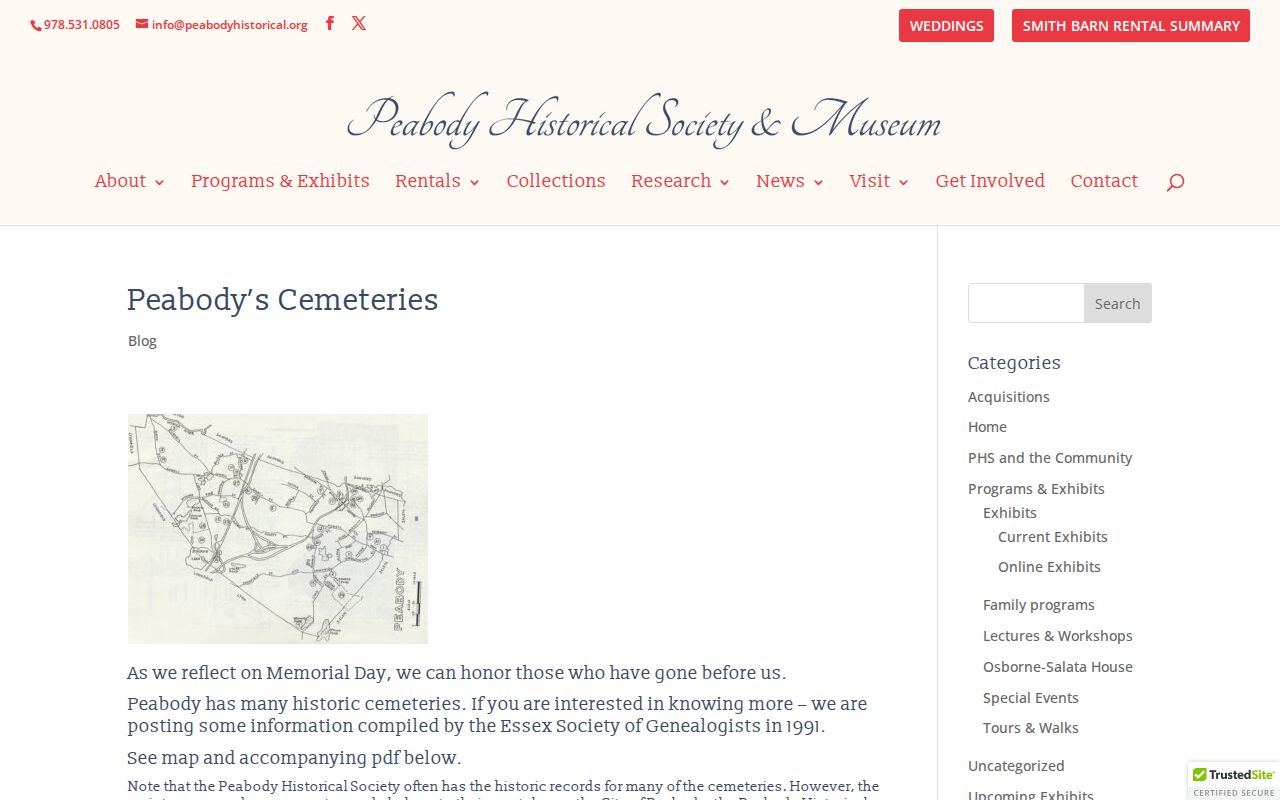
Pair a cemetery lead with an obituary, death record, or family paper before assigning it to a directory household.
Note: Historic cemetery references and current burial records can have different custodians, so ask for the specific record and date range needed.
Peabody Directory Timeline
The directory shelf fits into a longer Peabody records timeline. The Sutton Room holds the City of Peabody collection from 1796-2015, assessor records from 1856-1893, valuation records from 1861-1922, and municipal reports. Those collections provide a local paper trail around the directory years. Newspaper materials reach from 1844 forward, and the Registry’s older index-book images reach to 1640. These sources overlap without being interchangeable.
| 1855 | South Danvers separated and incorporated, a key name to search in earlier local records. |
|---|---|
| 1859 | First year in the library’s Peabody street-directory holding statement. |
| 1868 | The town adopted the Peabody name, changing a major index term. |
| 1916 | Peabody incorporated as a city. |
| 1951 onward | Essex South says modern electronic indexing is strongest from this period, while older electronic coverage may be incomplete. |
Dates explain where to look, not what a particular household did. Cite the actual volume and page, then keep the supporting record with it.