
Finding Peabody Resident Records
Begin with the kind of fact that can be checked. A current parcel can connect a Peabody address to an assessor owner. A deed can show the parties to a transfer. A directory can place a household at an address in a given year. Each record answers a narrower question than a general people list, which makes the result easier to test. Names also need a second point of comparison, such as a street, a date, a spouse notation, or a court division.
Official sources have limits. A parcel owner may not live at the mapped property. A voter-status form is intended for the individual voter, not a broad name search. A deed records an ownership transaction, not every occupant. The Peabody residents directory works best when those distinctions are kept intact from the first search through the final confirmation.
- Start with a known Peabody street address in MapGeo and save the map or parcel identifier.
- Use the owner name and address in the Essex South Registry index to identify a document trail.
- For an individual checking their own status, use the state form with the required name, birth date, and residential ZIP.
- For a past household, compare a city directory year with the census, obituary, or library collection closest to that date.
- Ask the correct custodian for an existing record when the online index does not carry it.
Peabody Records Custodians
Peabody sits in Essex County, but the usable trail runs through city, registry, court, library, and state offices. The City Clerk keeps local vital and election-related materials. The city parcel viewer presents current property data. Essex South maintains land records. None is a complete resident roster. Together they supply different, checkable pieces of the Peabody residents directory. The address-by-address process is developed further in the Peabody street directory.
Essex South Registry of Deeds
100 Cummings Center, Suite 206-C
Beverly, MA 01915
978-542-1704
Peabody City Clerk
24 Lowell Street
Peabody, MA 01960
978-538-5756
Peabody District Court
1 Lowell Street
Peabody, MA 01960
978-532-3100
For a request that is not tied to a specialized file, Massachusetts Public Records Law, M.G.L. c. 66, §10, favors a written request that identifies existing records, dates, and preferred format. The initial response framework is generally ten business days. Agencies can redact exempt material and do not have to create a new resident list.
Peabody Parcels Before Names
Peabody MapGeo is the useful first stop when an address is already known. Its Property Quick Search and map navigation lead to the parcel context. The city reports parcel and FY2026 property data updated in January 2026, while also warning that data can change and must be verified with the custodian. A parcel is a defined piece of land. It is not a promise that the named owner occupies it.
The supporting ArcGIS parcel layer separates the displayed owner from owner mailing fields, mailing city and ZIP, and the map/parcel identifier. That split matters. A tax mailing address can point to where the owner receives correspondence, while the situs is the place where the parcel sits. The two are not interchangeable evidence in a Peabody residents directory search.
The Peabody MapGeo viewer shows the parcel search surface used for this address-first check.
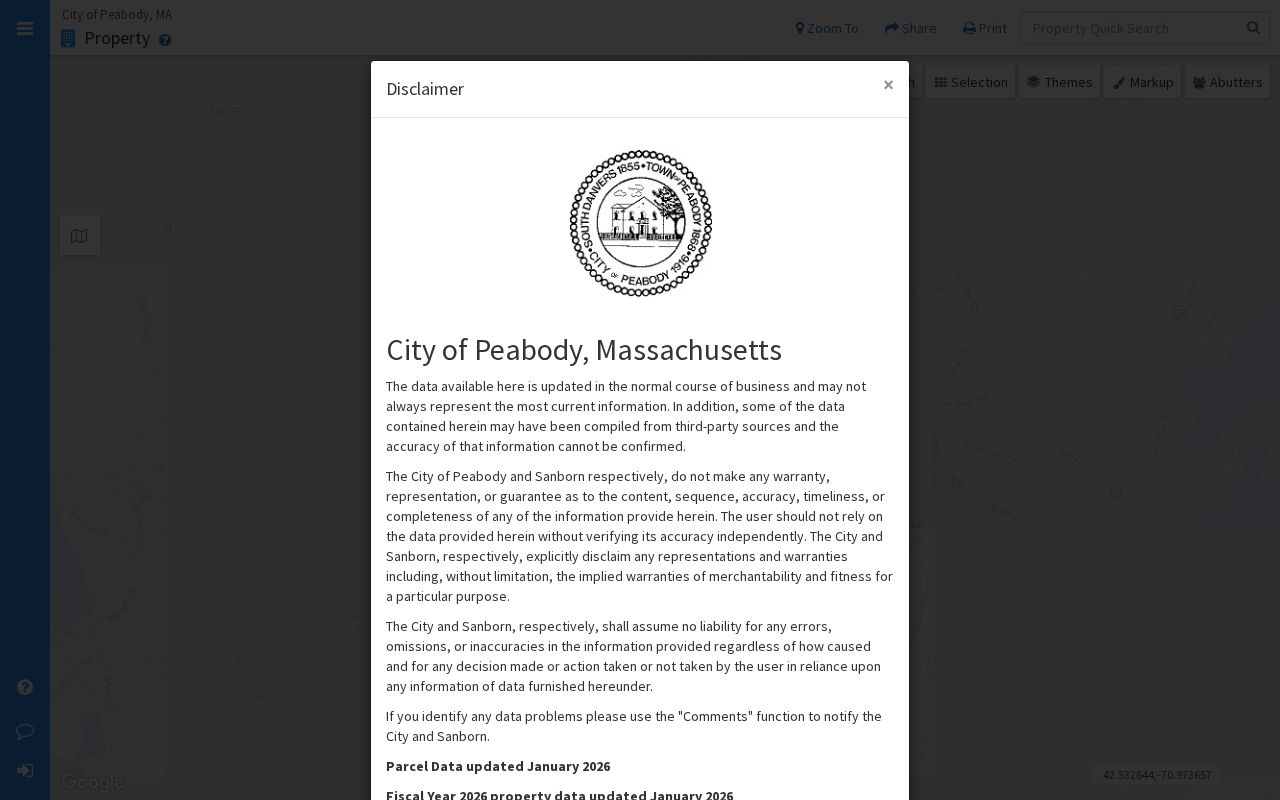
Use the visible parcel boundaries to confirm the mapped site before treating an owner field as a lead for another record.
- Parcel
- A mapped unit of property identified by an assessor map or parcel number.
- Situs
- The physical location of the parcel, usually the address used for map and permit work.
- Mailing address
- The address supplied for tax correspondence, which may be somewhere else.
- Index
- A finding tool that points to a record, rather than the complete official file itself.
Peabody Parcel Field Clues
The ArcGIS layer gives the Peabody residents directory a concrete field set without claiming more than the public data shows. OWNER or OWNER1 is the owner display field. OWN_ADDR or ADDRESS, OWN_CITY or CITY, and OWN_ZIP or ZIP_CODE describe the owner mailing trail. MAP_PAR_ID identifies the assessor map and parcel. Geometry supplies the parcel shape. The research did not verify every possible MapGeo popup field, so building details and values should not be assumed from the layer alone.
| Parcel field | How to read it |
|---|---|
| OWNER / OWNER1 | Assessor owner attribute, not proof of occupancy |
| OWN_ADDR / ADDRESS | Owner mailing address, separate from the mapped situs |
| OWN_CITY and OWN_ZIP | Mailing location clues for the owner |
| MAP_PAR_ID | Identifier that helps match deeds, maps, and a parcel |
| Geometry | Polygon used to see the parcel’s position and edges |
The ArcGIS Peabody parcel layer displays the owner, mailing, ZIP, and map-parcel fields behind the map.
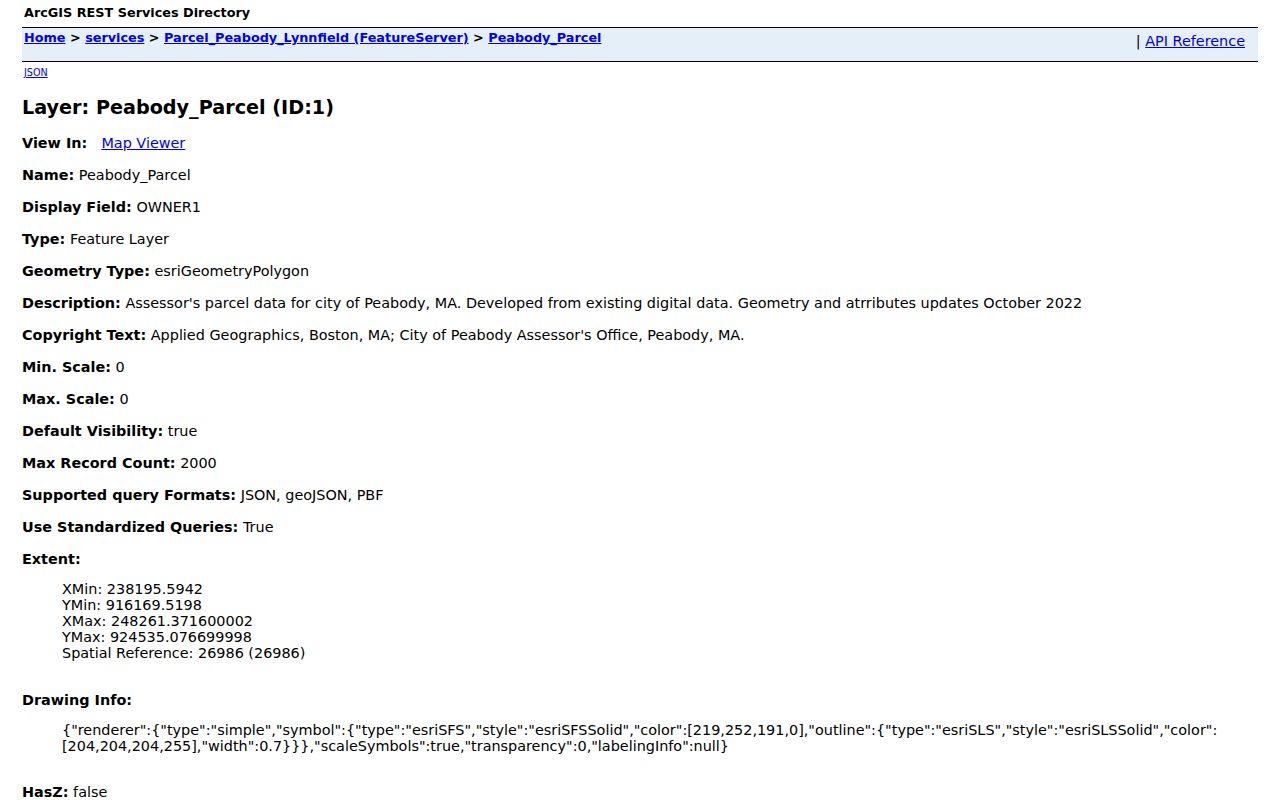
Those attributes make a parcel a solid starting point, but the next record should be a deed, a city file, or an archival source that fits the question.
Peabody Voter Status Boundaries
The state’s individual voter-status form is not a Peabody residents directory by name. It requests first name, last name, full date of birth, and a five-digit residential ZIP, then asks the user to agree it is for the individual voter. Massachusetts central voter names and addresses are not a general public record under M.G.L. c. 51, §47C. The city’s January 1 listing is a separate municipal record with its own access and confidentiality rules.
The annual form tells recipients to list people living at the address, correct changes, and return the form within ten days. It carries ward and precinct context as well as personal fields. Confidential voters and protected information are excluded from ordinary disclosure. A status result can also lag a recent move, so it is not a live occupancy check.
Massachusetts My Voter Registration Status shows the individual-use form and its required identity fields.
The form’s narrow purpose is the key takeaway: use it to check one’s own status, not to assemble a block or household list.
Peabody Deed Index Trail
The Essex South Registry of Deeds links a Peabody parcel to recorded land documents. Its current search family includes name, address, date and document type, and book and page modes. In a name search, grantor means the party transferring an interest and grantee means the party receiving it. That sequence can help trace ownership. It does not establish who occupied a home on every date.
Address searching asks for a street number and street name, date range, town, and optional document type. The classic street shortcut begins in 1995 and covers only deeds and conveyances. For earlier material, the Registry has index-book images from 1640 through 1979. It specifically cautions that electronic indexes before 1979 may be incomplete or absent. The safer fallback is to browse nearby image-index pages, consult plans, or ask the Registry counter for help.
| Record path | What it can support | Access route |
|---|---|---|
| Recorded Land name index | Parties, dates, document types, book and page | Free online index; images have a payment area |
| Address search | Modern street-linked deed and conveyance leads | Registry address search with dates and town |
| Index-book images | Older name access where electronic coverage is weak | Registry image groups and counter assistance |
| Plans and atlases | Lots, boundaries, and legal-description context | Registry plan search and historical repositories |
Current Peabody Directory Sources
No single modern source lists every Peabody resident. Use the source whose scope matches the question. MapGeo connects an owner to a parcel. The Registry lists parties to land documents. Court and vital sources require a more specific purpose and often a direct request. The local annual street listing can be a municipal record, subject to statutory privacy limits. These current trails are less broad than a general directory, but each has a named custodian and a way to verify it.
| Source | What it can show | Custodian | Access |
|---|---|---|---|
| MapGeo parcel layer | Owner, mailing fields, parcel identifier, geometry | Peabody assessor data | Public map and ArcGIS layer |
| Recorded Land index | Grantors, grantees, document placement | Essex South Registry | Online index, images, counter |
| Annual street listing | January 1 address-related city listing | Peabody City Clerk | City process, confidentiality rules |
| Vital-record request | Eligible local birth, death, or marriage record | Peabody City Clerk | In person, mail, or online payment channel |
| MassCourts | Public case-party and docket information | Massachusetts Trial Court | Remote portal and court terminal |
A name that appears in one of these sources still needs context. A one-person confirmation needs court, vital-record, and privacy limits that match the record being checked.
Peabody Court Record Checks
MassCourts can supply another way to distinguish people with the same name. Its public instructions use Name, Case Type, Case Number, and Ticket/Citation Number tabs. A name search is limited by the instructions, and criminal cases may require an exact docket number. Results may include party name, case number, court department, filing date, events, and disposition details. A docket is an index of case activity, not a finding about a person.
The remote service warns that it is not the official court record and may not have the latest action. For a public official copy or material that is not remotely available, use the clerk, register, or public terminal at the court where the case was filed. Juvenile, sealed, expunged, impounded, adoption, and confidential family records are not ordinary public name-search results.
MassCourts public case access is the online entry point for the separate court-record step.
The screen’s public-record warning reinforces why a court name match needs an address, date, division, or docket cross-check.
Peabody Vital and Custody Paths
The City Clerk can issue certified Peabody birth, death, and marriage records when local filing rules apply. The local instruction lists in-person, mail, and online-payment routes, and charges $10 per certified copy. A birth is held locally when the child was born in Peabody or the parents lived there at birth. A marriage is held when intentions were filed in Peabody. A death is held when the person died in the city or was a Peabody resident at death.
Massachusetts state and archive custody fills other date ranges. State guidance places 1936-present records with the Registry of Vital Records and Statistics and 1841-1935 research records at the State Archives. Identification, relationship, or other documentation can be required, and special categories are restricted under M.G.L. c. 46. Use vital records to confirm an event through the proper channel, not to infer an address from a name alone.
For a limited custody check, the Massachusetts DOC locator instructions describe online and phone access by full name or commitment number.
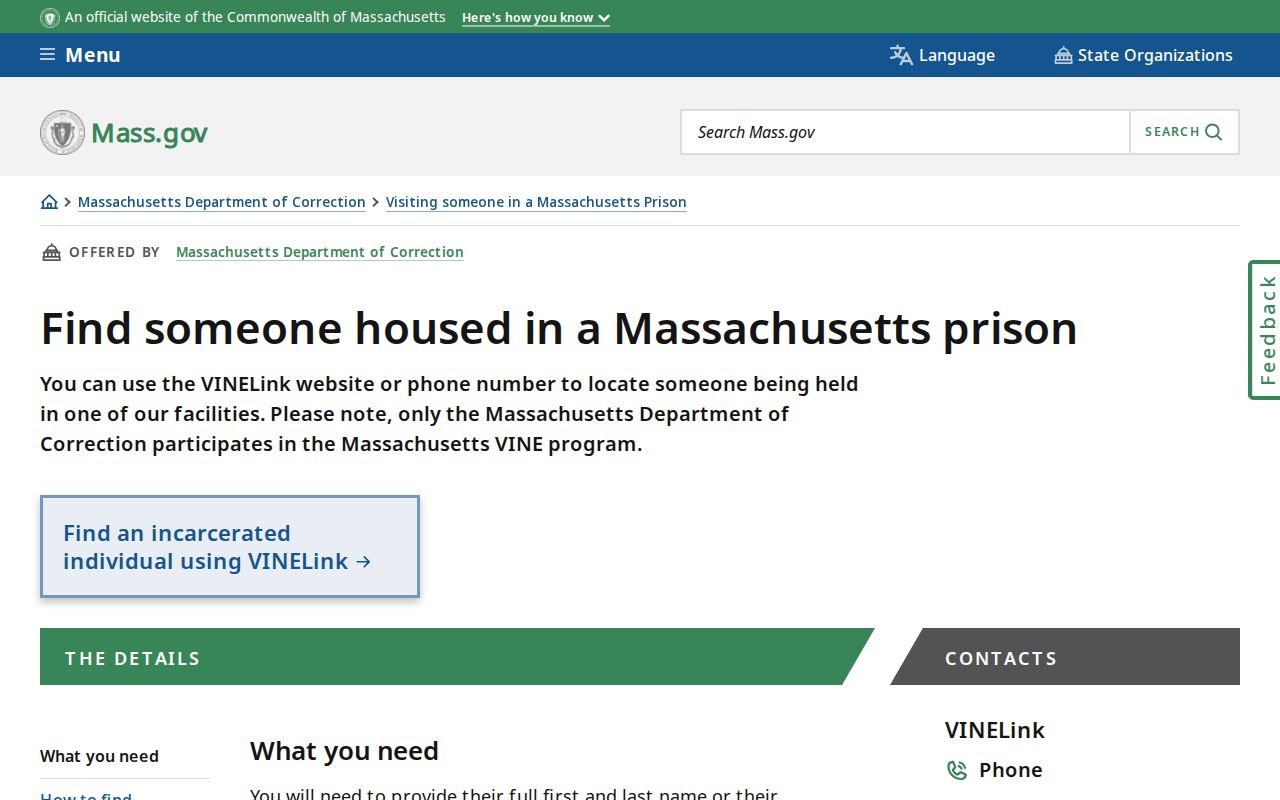
That state tool concerns Massachusetts DOC custody only; it is not an Essex County jail roster or a general resident record.
Peabody Historical Directory Shelves
The strongest historical Peabody residents directory source is the Peabody Institute Library’s Sutton Room. Its local-history collection reports street directories from 1859 to the present, plus voter lists, street lists of polls, assessor papers, valuation records, newspapers, maps, church papers, and school registers. The State Library also lists selected Peabody directory runs from 1873 through 1983. A volume can be alphabetic by person or organized by house or street, so the title and index need to be checked before searching it.
Old records also need old place names. South Danvers separated from Danvers in 1855, became Peabody in 1868, and incorporated as a city in 1916. A family or parcel that disappears under Peabody may still be indexed under South Danvers, Danvers, or Salem. That geography bridge is especially useful for family history and older deed work. The full shelf-by-shelf treatment is on the Peabody city directory page.
Peabody Archives Fill Gaps
The Sutton Room’s City of Peabody collection spans 1796 to 2015. Its listed assessor papers reach 1856-1893, valuation records 1861-1922, voter-registration lists 1877-1974, and street lists 1891-1966. Those ranges help bridge a gap between a present parcel and a printed directory. The library provides local-history appointments, archive and catalog searches, and a microfilm reader. For newspaper work, the archive runs from 1844 forward, but material from July 1979 to the present is available only on a library computer because of copyright.
Peabody’s historical record geography also changes before the city name appears. A directory, deed, church paper, or newspaper notice may use Salem, Danvers, or South Danvers instead. Compare those place names with the date on the record. That small check can explain why a family, parcel, or business does not appear under the modern city label.
The Peabody Institute Library local-history collection identifies the Sutton Room and its research channels.

Library staff and microfilm access matter when a missing directory year or obituary cannot be found through a web index. Peabody newspaper research also benefits from trying a surname, a street, and a spouse or neighborhood term separately.
Peabody Record Safety Checks
Use a second source before treating a record as settled. A deed trail should be compared with the parcel and, for earlier years, the directory or census. A cemetery mention should be checked with its holder. A court result should be checked against the proper docket or clerk file. This method reduces false matches without turning one public reference into a claim about a person’s present life.
| Source type | Useful strength | Check before relying |
|---|---|---|
| Named public custodian | States the record’s keeper, scope, and access route | Whether the record actually covers the person, parcel, and date |
| Historical library or archive | Preserves directory, map, newspaper, and manuscript context | The volume year, arrangement, and any missing issues |
| Compiled commercial profile | May suggest a fact to verify elsewhere | Its date, source, identity match, and whether an official record agrees |
For Peabody family research, the best result is usually a small chain of records that agree on the same name, place, and time. A custodian’s original file or a dated library volume carries more weight than a profile that does not disclose its underlying record.
Property monitoring offers one focused safety tool. Massachusetts Registry property-fraud alerts provide a free notification when a document is recorded in a person’s name and list Essex Southern among the registries. An alert is a prompt to verify a filing with the Registry, not proof that fraud occurred. Confirm a suspicious letter or copy offer through the official office before paying anyone.
The state’s property-alert information explains the official notification service available to Essex South users.

A careful record trail ends with custodian verification, especially when a portal, collection, or access rule has changed.